Two riding traditions
Doma vaquera and alta escuela
Two riding traditions behind a Spanish horse show: doma vaquera from cattle work and alta escuela from classical dressage, with plain-English definitions.
Reserve a place at the show ↗Two schools in one arena
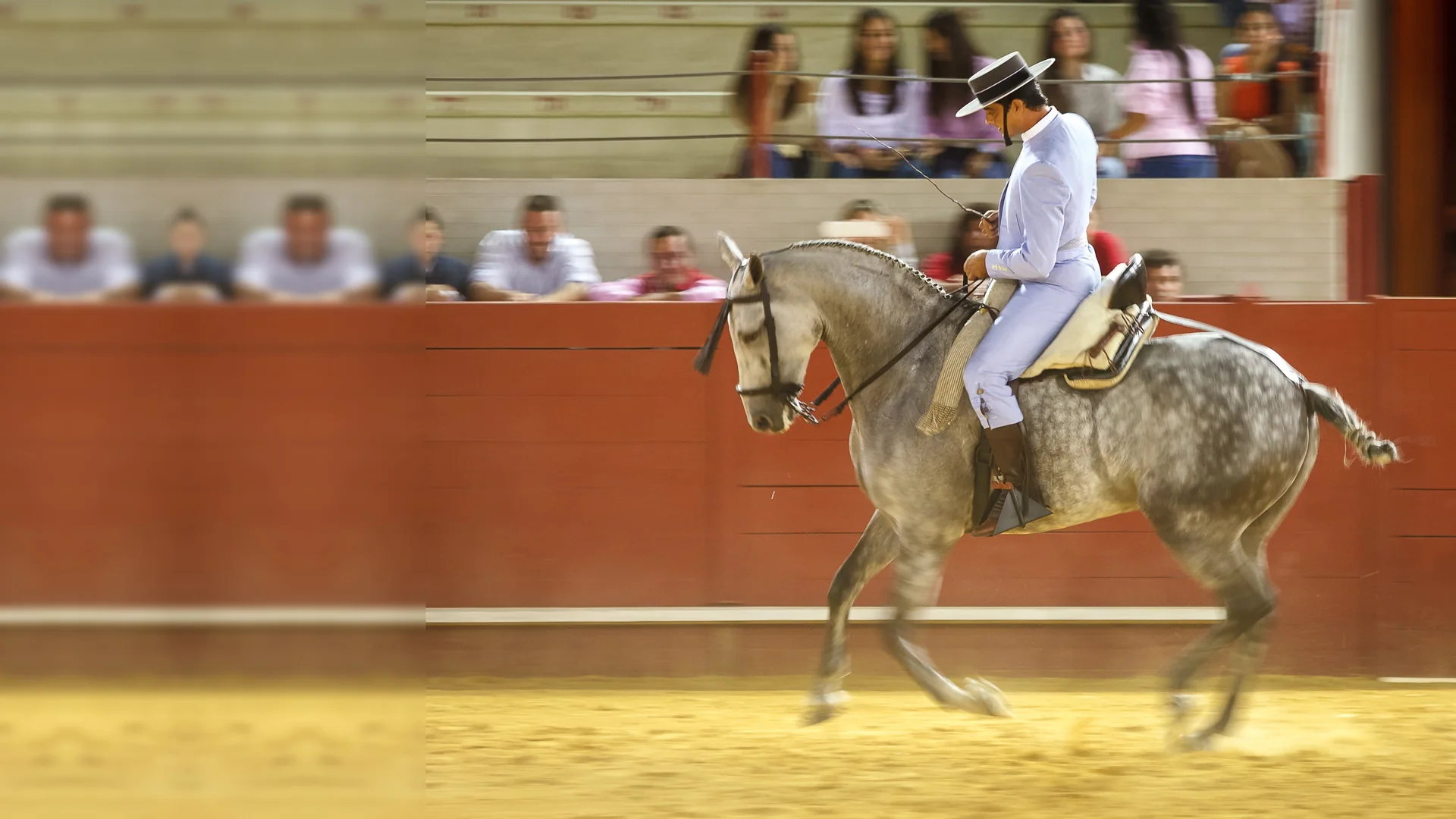
A Spanish horse show can borrow from two riding schools. Doma vaquera comes from the countryside, from work with cattle. Alta escuela, the “high school”, comes from classical dressage and the riding academies. The El Ranchito ticket describes a mixture of cowboy moves and high-level dressage, so both vocabularies are in play, and this guide explains each in plain English.
What doma vaquera is
Spain's equestrian federation, the RFHE, says that doma vaquera consists of performing, in succession and within a rectangle, a series of exercises taken from those carried out in the field to work with cattle. It is a federation discipline with its own rules, its own competition levels for young riders and for young horses, and its own national championships each year. The RFHE's own page lists doma vaquera among its disciplines, beside show jumping and classical dressage, which tells you how established it is.
Not the same as doma clásica
Wikipedia stresses that doma vaquera is distinct from the classical Spanish haute école, or doma clásica. It also lists doma vaquera alongside rejoneo, mounted bullfighting, and acoso y derribo, a cattle-working skill, as Spanish riding traditions of their own. They share a country and a horse type but have different aims, which is why a show can feel like a mix of styles.
The rider in the rectangle
Because the exercises are performed inside a rectangle, the work looks tidy and repeatable. Turns, stops, changes of pace and changes of direction follow one another in a sequence. The sequence echoes the sudden moves a herder needs in a field, and it is what the phrase cowboy moves is pointing to in a show description.
Dressage in a nutshell
Dressage has ancient roots in the writings of Xenophon, and modern dressage has developed since the Renaissance, when Federico Grisone's treatise on riding was published in 1550. Much of today's competitive training reflects classical practice. For a spectator the useful point is simple: dressage is about control and cooperation, and the best work looks effortless, with the rider's signals almost invisible.
What classical dressage means
Classical dressage evolved from cavalry movements and training for the battlefield. Today it is described as the art of riding with the horse as a partner rather than an opponent, with a rider who sits well, moves with the horse and applies the aids at the right time. Its traditions are kept alive in a handful of historic academies in Europe.
The idea of collection
Collection is the horse gathering its power: lifting the forehand, raising the neck and flexing at the poll. Horses do this naturally when playing or showing off to others, and dressage trains it into a controlled form. A collected horse moves with more upward energy and is ready to turn or stop at once.
High school and the airs
“High school” means the advanced movements of classical dressage. Among them are the “airs above the ground”, a set of movements where the horse leaves the ground, such as the levade, courbette and capriole. Wikipedia notes that these are not used in modern competitive dressage and are shown at classical academies. Whether any appear in a particular show is for the organiser to say.
Reading what you see
At a show, watch the rider's hands and legs. In classical riding the signals are meant to be small, and horse and rider appear to move as one. In cowboy-style riding, look for sudden changes of direction and pace. Guests who review El Ranchito often mention riders who seem close to their horses.
Questions to ask on the day
If you take the stable visit, the guide can tell you how the horses are trained and how long that takes. Guests who did the visit say the guides know a great deal. Ask about the horses' daily routine, too, and how they are cared for in summer heat, when the arena relies on fans and misting systems.
Sources