The breed behind the show
The Andalusian horse, explained
The Andalusian, or Pura Raza Española: where the Spanish horse comes from, how it looks and moves, and why it suits the arena at a Costa del Sol horse show.
Reserve a place at the show ↗One breed, two names
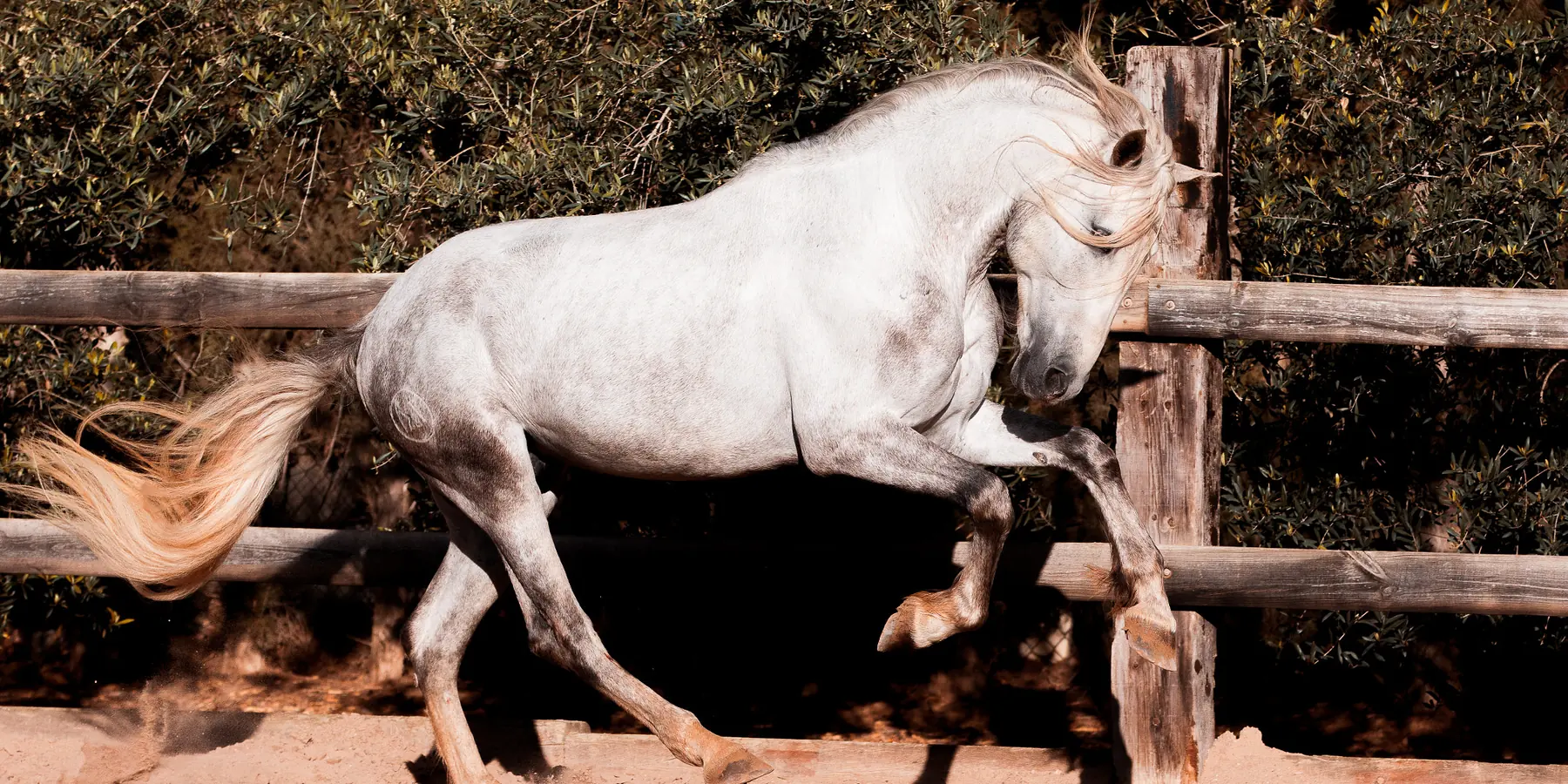
The Andalusian is also called the Pura Raza Española, or PRE, which English renders as the Pure Spanish Horse. The Spanish association that keeps the stud book prefers the Spanish name, while much of the world says Andalusian, and in most places the two terms mean the same breed. Spain's Ministry of Agriculture recognises that association, founded in 1972, as the body for breeders and owners everywhere. If you read a show programme that uses either name, it is describing the same kind of horse. Either way, the horse is the same animal.
Named for a region
The name comes from Andalusia, the southern Spanish region where the breed developed, and its ancestors are the horses of the Iberian Peninsula, in Spain and Portugal. It is a close relative of Portugal's Lusitano. Its status as a separate breed goes back to the 15th century, and its conformation has altered very little since. Cave paintings show horses living on the Iberian Peninsula tens of thousands of years ago, long before the breed existed.
A horse for kings and cavalry
Across its history the breed was prized as a war horse and by the nobility. Spain used horses as a tool of diplomacy, and kings across Europe rode and owned Spanish horses. Every French monarch from Francis I to Louis XVI had equestrian portraits made on Spanish-type horses. The breed also shaped others, including many warmbloods of Europe, and gave its blood to riding breeds in the Americas.
The monks and the pedigrees
Some of the earliest written pedigrees in European history were kept by Carthusian monks, beginning in the 13th century, because monks could read and write. A strain within the breed, the Carthusian, is regarded by many breeders as the purest. The claim is a matter of breeders' belief, as no genetic evidence for it is known, but the strain remains separate and is preferred by some buyers.
A close call and a recovery
In the 19th century wars, disease and crossbreeding reduced the herds sharply, and numbers stayed low into the early 20th. Horses were stolen or requisitioned in wartime, and one herd was hidden from invading armies and later used to renew the breed. Exports from Spain were restricted until the 1960s, and since then the breed has spread worldwide, though it remains a relatively small population.
How it looks and moves
Andalusians are strongly built, compact yet elegant, with a long broad neck, a short back and long, thick manes and tails. Grey is the most common coat, though bay and others occur. Their movement is described as extended, elevated, cadenced and harmonious. They are known for agility and for learning difficult moves, such as collection and turns on the haunches, quickly.
Temperament
Andalusians are described as intelligent, sensitive and docile. When treated with respect, they are quick to learn, responsive and cooperative. That combination matters in a show, where a horse works close to an audience, music and a dancer, and where the rider's signals must stay small and calm. Calm temperament is as important as athletic ability when the audience is a few metres away.
Why it suits the arena
A horse that picks up collected, elevated movement readily suits dressage and cowboy-style riding alike. Historically the Andalusian served in classical dressage, driving, bullfighting and the working of livestock, and today it also appears in dressage, show jumping and driving. At a show such as the Torremolinos one, the organiser is the one to confirm which breed each horse is.
Spotting the signs
Look for the arched neck, the thick mane and tail, the high, rounded steps and the calm eye. If you want to know what the riders are asking of the horse, the guide to doma vaquera and high school riding explains the vocabulary.
Read next: Doma vaquera and alta escuela
Sources